
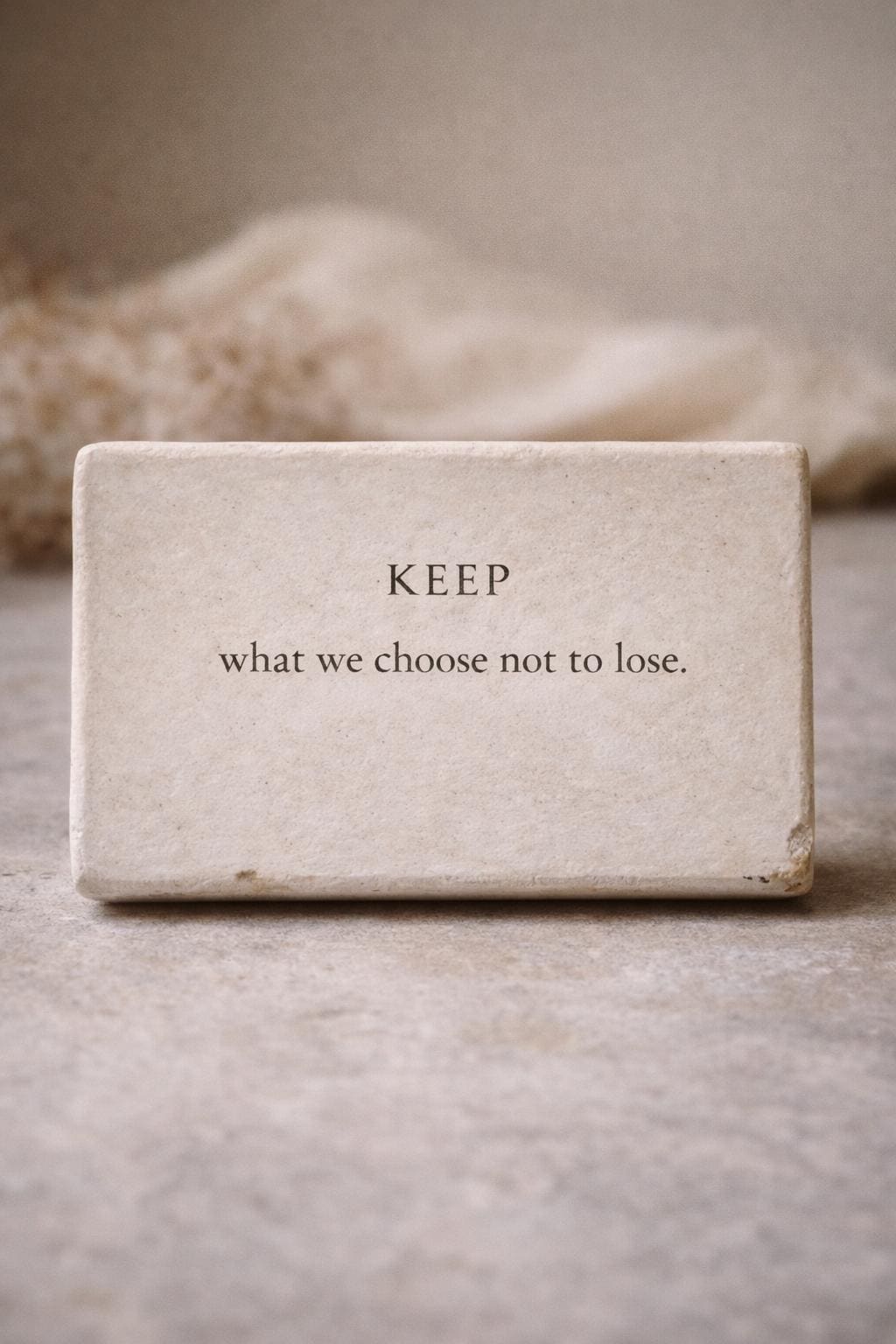
Not everything has to pass.Some things do not ask to be remembered out of nostalgia, but to be kept by choice.
KEEP is born from a simple gesture: not letting everything slide away.Not to stop time. Not to deny loss. But to say that what had meaning deserves a form, even when it is no longer here.KEEP does not speak only of death. It speaks of what remains when something leaves. Of names that risk silence. Of places no one looks at anymore. Of gestures that can still be made.To keep is not to possess. To keep is to take care.Sometimes it is a word. Sometimes a name written. Sometimes a stone cleaned. Sometimes an object made to last.KEEP is thought, gesture, form. Against time not with force, but with care.
A Line of Those Who Chose to Keep
At the beginning there were no books. There were voices.People spoke the names of the dead around the fire, because if no one named them, it was as if they had never existed. Homer did this: he took names and made them stronger than time. Achilles lives not because he was great, but because someone said his name.To keep was to tell.Then the Greeks looked at death and said: it is not only fate, it is a wound. In Sophocles and Euripides, pain is not heroic. It is human. Antigone does not fight for power, but to bury her brother. Because without burial there is no peace. Not for the dead. For the living.To keep became to bury, to give a place, not to leave the body to silence.The Romans were harder. Seneca wrote that death is natural, but dignity is a choice. Memory was not crying. It was discipline. To remember well meant to live better.To keep became exercise.In the Middle Ages, with Augustine and then Dante, memory moved inside. Not only in graves, but in the soul. Dante made the dead speak, not only to judge them, but to listen to them. As long as someone listens, no one is truly mute.To keep became listening.With the Renaissance, Montaigne wrote that thinking about death teaches us how to live. Not from fear, but from clarity. Writing was a way to hold what escapes.To keep became writing.Then came Foscolo. He was clear: death is nothing. But the tomb is everything.Not for those who die. For those who remain.The grave is a gesture against oblivion. It does not save the soul. It saves the name.To keep became making signs.Leopardi saw that humans live from what they cannot have. Memory is sweet because it hurts. It keeps us alive because it is missing.To keep became lucid nostalgia.Rilke said that death belongs to life. Every loss changes our shape. Absence is not emptiness. It is a different form.To keep became transformation.In the twentieth century Freud said that mourning is a work. You do not heal. You become something else.Proust showed that the past lives in a taste, a smell, a small gesture. Not in monuments, but in details.To keep became attention.Heidegger said that we are beings-toward-death. Knowing we end makes us true. Camus answered: because everything ends, we must create meaning.To keep became choice.
And Today
Today we no longer have strong rituals. We no longer have shared words for loss. But the ancient gesture remains:Someone takes what is about to disappear and says: “No. This stays.”A name written. A stone cleaned. An object made. A word spoken.From Homer to today, forms change. But the gesture does not.To keep.Not to stop time. But not to let it take everything.
KEEP — What We Choose Not to Lose
- Not everything must be saved. But something must be kept.
- To keep is not to own. It is to care.
- We do not defeat death. We defeat oblivion.
- What you choose to keep tells who you are.
- Time takes everything. Except what someone decides to keep.
- To keep is an act. Not a feeling.
- We do not stop time. We give it form.
- Absence is not empty. It is a different shape.
- Not everything deserves to last. But what had meaning, yes.
- Every gesture that stays is a silent resistance.