
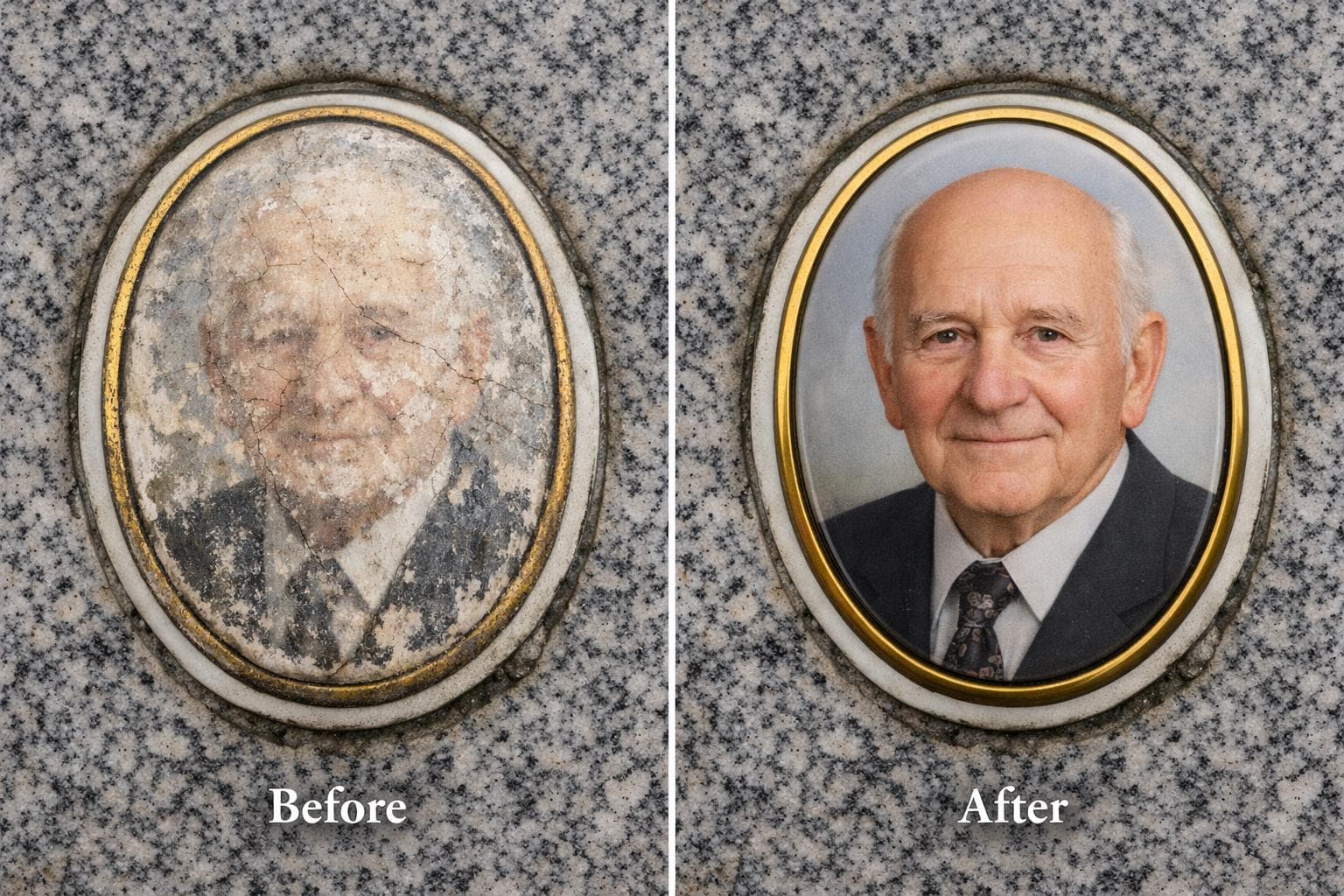
About time, outdoor surfaces, and the decision that comes after.
There is a moment when a memorial photo is still there,
but no longer does its job.
Not because the memory has changed.
Not because someone forgot.
Time works quietly on surfaces.
Light, weather, years.
When that happens, the question is not emotional.
It is practical:
does this image still represent what it was meant to represent?
Time is not damage
Outdoor memorial photos change slowly.
Porcelain, metal, glass — none of them are immune to time.
Fading, loss of contrast, surface wear are not signs of neglect.
They are simply what happens when something stays outside long enough.
Time does not erase meaning.
It works on materials.
And sometimes, what changes is not the memory,
but the legibility of the image that carries it.
When replacement is not the point
Often, the first idea is replacement.
A new photo.
A new image.
But replacement is not always the most accurate gesture.
Sometimes the image is still the right one.
It belongs to that place.
It has been there long enough to become part of the landscape.
What is missing is not meaning,
but clarity.
Restoration as clarity
Restoration is not about improvement.
It does not add emotion or interpretation.
It works on contrast.
On balance.
On legibility.
It allows the image to do again what it was originally meant to do:
stay, and be understood.
Not brighter.
Not newer.
Just readable.
The decision comes later
This decision rarely comes immediately.
It comes after.
When urgency is gone.
When things have settled.
When someone notices that what once worked, now doesn’t —
and quietly decides to restore order.
Not to change the memory,
but to let it remain.
What remains readable
Not everything that time touches needs to be replaced.
Some things are meant to stay longer —
once they are made readable again